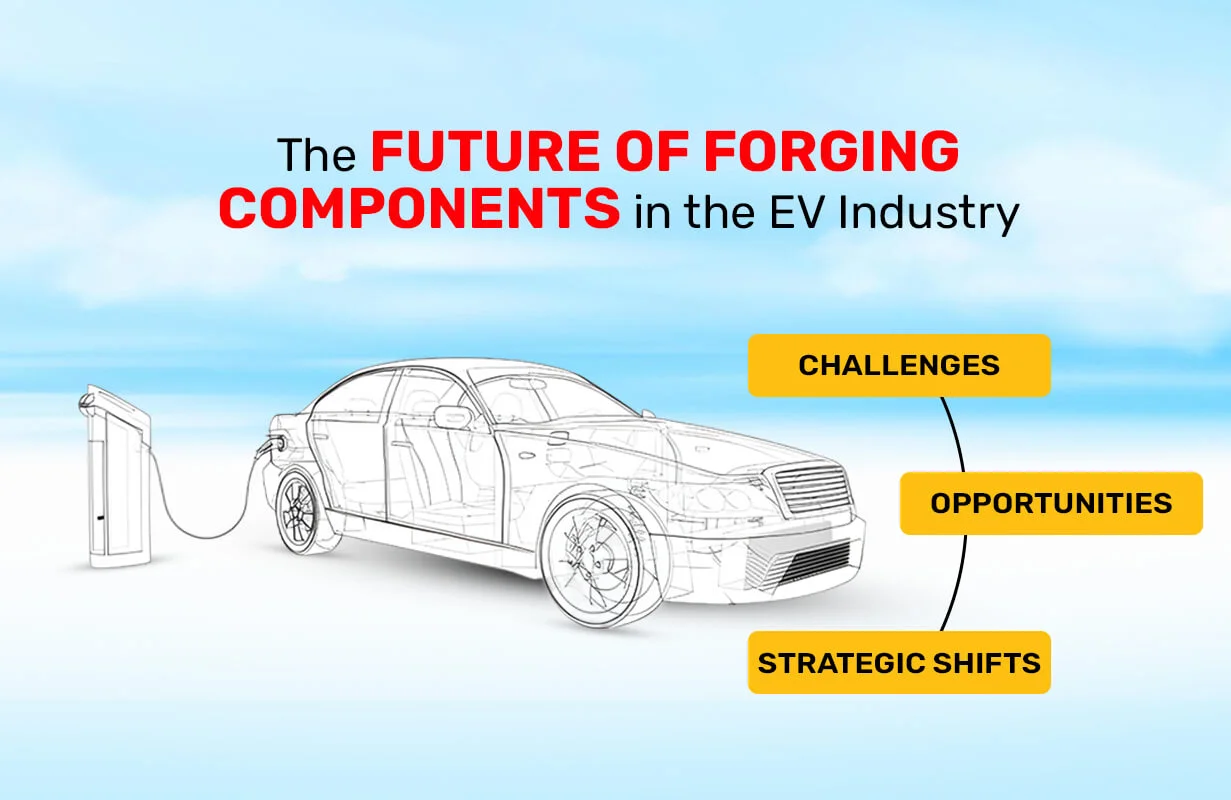
The shift from internal combustion engine (ICE) vehicles to electric vehicles (EVs) is more than just an automotive trend — it’s a structural transformation of the entire supply chain, especially for industries that have traditionally thrived on forging and component manufacturing.
In conventional vehicles, the ICE drivetrain can have around 2,000 moving parts, requiring a myriad of forged components such as crankshafts, connecting rods, gears, and transmissions. In contrast, most EV powertrains consist of far fewer moving parts — roughly 20 — significantly reducing the demand for traditional forged parts used in ICE drivetrains.
This sweeping change naturally raises serious questions for forging suppliers, automotive component manufacturers, and industrial service providers:
Is forging obsolete in the EV era? Or is its role evolving — and if so, how?
1. Why the EV Transition Disrupts Traditional Forging Demand
The electrification of vehicles is reducing the number of mechanical components required in the drivetrain — and forging demand follows suit. Forging units that once supplied piston parts, engine crankshafts, and transmission gears are seeing declining volumes as powertrain electrification accelerates. The Association of Indian Forging Industry estimates that up to 60% of forging capacity may become underutilized as EV adoption increases, due to the vast reduction in moving parts compared to ICE vehicles.
This isn’t unique to India; globally, forging suppliers must confront a similar reality as EV penetration rises.
However, this does not spell the end of forging — it signals a transformation of what, how, and where forged components are used.
Progressive manufacturers such as Sunstar Precision Forge Limited are already adapting by shifting capabilities toward EV-aligned components and advanced material applications.
2. New Forging Opportunities in EV Components
Despite the decline in traditional ICE-related forging demand, a new generation of forged components is emerging across EV architectures and related systems:
a) Lightweight Structural Components
EVs require lighter vehicles to improve battery range and efficiency. Forging with lightweight materials — such as aluminum alloys and high-strength steel — plays a key role in producing components like suspension parts, wheel hubs, motor housings, and structural brackets that maximize strength while minimizing weight. Precision-focused forging companies, including Sunstar Precision Forge Limited, are increasingly supporting OEMs with high-strength, lightweight structural parts optimized for EV platforms.
b) Powertrain & Motor Parts
While EV motors do not have pistons or crankshafts, they still require precision forged parts such as:
• Rotor shafts
• Couplings
• Motor housings
• Gear reduction mechanisms
Advanced forging techniques enable the high strength, fatigue resistance, and dimensional accuracy needed in these critical components, making forging indispensable to EV driveline reliability.
c) Battery & Thermal Management Components
Some forged components support battery pack housings and thermal management systems — vital for safe, efficient EV operation. High-integrity forgings withstand thermal cycling and mechanical stress far better than cast parts, particularly in high-voltage and high-load environments.
3. Innovation and Digital Transformation in Forging Operations
Forward-looking forging companies are not waiting for demand to vanish; they are reinventing operations and capabilities:
a) Digital Twins and Real-Time Monitoring
Industrial leaders are leveraging digital transformation to build “dark factories” where machine performance, forging processes, and predictive maintenance are monitored in real time — reducing downtime and improving quality.
b) Automation & Advanced Manufacturing
Automated forging and precision control through robotics, AI, and predictive analytics are enabling higher throughput, reduced waste, and tighter tolerances — essential for EV component competitiveness. Companies like Sunstar Precision Forge Limited are investing in such advanced manufacturing practices to meet the evolving expectations of EV OEMs and Tier-1 suppliers.
c) Material Innovation
Forging with advanced materials like high-strength aluminum, magnesium alloys, and hybrid composites supports EV needs for lightweighting and performance. These alloys are gaining traction as part of sustainable design trends across the EV ecosystem.
4. Strategic Shifts: Diversification Beyond Automotive
Experts suggest that forging companies need to diversify beyond traditional automotive parts to maintain capacity utilization and growth. Potential alternatives include:
• Defense & aerospace components, where high-integrity forged parts remain essential
• Infrastructure and rail applications, where forged structural components deliver superior strength
• Renewables and energy segments, such as wind turbine components and heavy machinery parts
This strategic pivot allows forging manufacturers to apply their expertise to sectors with sustained or growing demand.
5. How Forging Suppliers Can Stay Relevant in the EV World
To remain competitive and future-ready, forging businesses should pursue strategic actions such as:
• Re-tooling facilities for aluminum and lightweight alloy production
• Investing in Industry 4.0 technologies for operational efficiency
• Partnering with EV OEMs and Tier-1 suppliers to co-develop next-gen components
• Expanding into adjacent industries such as defense and industrial machinery
This approach not only mitigates the negative effects of declining ICE-related demand but transforms forging into a core capability in the EV supply network.
Conclusion: Evolving, Not Ending
Yes, the rise of EVs is reshaping the forging industry — but it is not rendering it obsolete. Instead, it is accelerating a transition toward lighter, stronger, and more specialized forged components that fit the unique demands of electric vehicles and adjacent advanced sectors.
Forging manufacturers that invest in innovation, agility, and strategic diversification — such as Sunstar Precision Forge Limited — will find themselves at the forefront of the evolving EV value chain, powering not just automotive transformation but the wider future of advanced manufacturing.