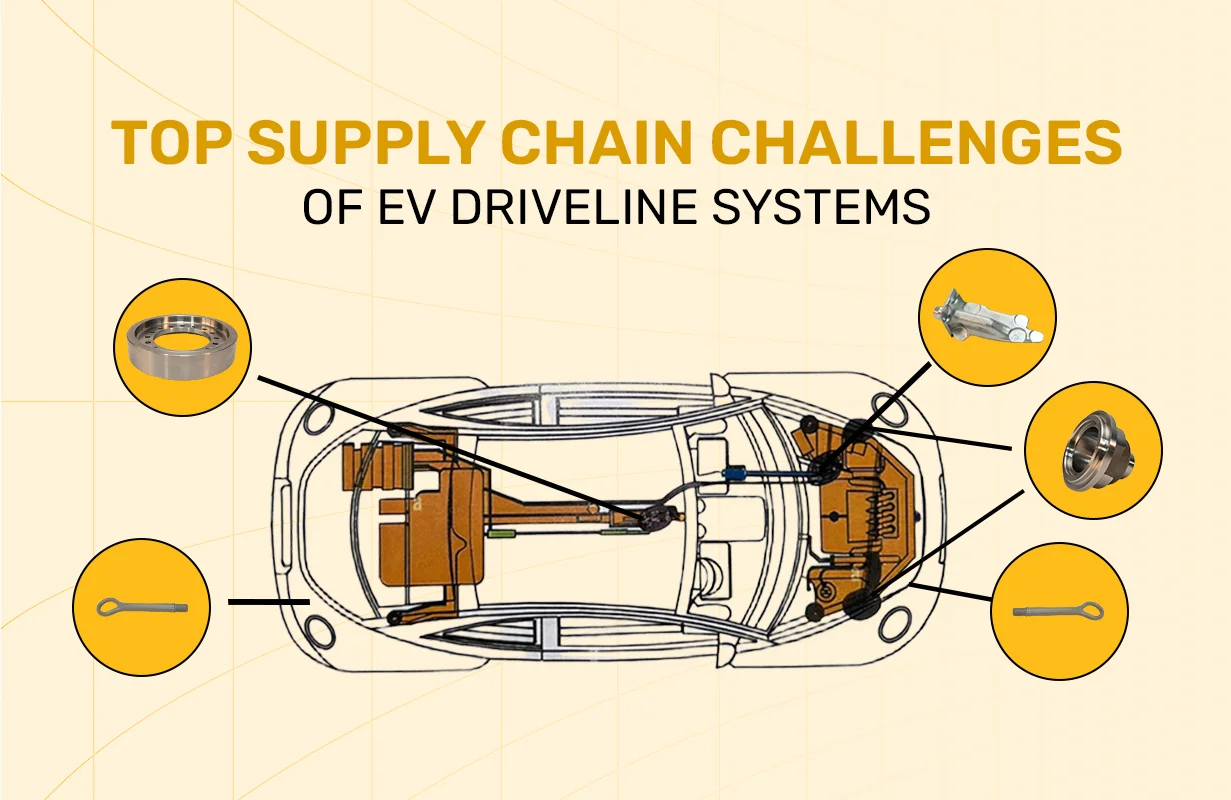
What are the primary supply chain challenges impacting the production scalability of driveline systems for electric vehicles?
The production scalability of driveline systems for electric vehicles (EVs) faces critical supply chain bottlenecks, primarily driven by material shortages, geopolitical constraints, and manufacturing complexities. Rare earth elements such as neodymium and dysprosium, essential for high-performance permanent magnets in electric motors, are constrained by limited global reserves and geopolitical dominance. China controls approximately 60% of rare earth mining and 85% of processing capacity, creating vulnerability for manufacturers reliant on single-source suppliers. For instance, in 2022, export restrictions on rare earth materials from China disrupted production timelines for European automakers like Renault and BMW, delaying delivery of key driveline components.
Semiconductor shortages further exacerbate scalability challenges. Advanced driveline systems require specialized power electronics, including insulated-gate bipolar transistors (IGBTs) and silicon carbide (SiC) chips. The automotive industry’s shift toward EVs has intensified competition for these components, with lead times for SiC chips extending to 52 weeks in 2023. Tesla’s decision to vertically integrate power electronics production highlights the severity of this bottleneck, as traditional tier-1 suppliers struggle to meet demand.
Battery cell shortages indirectly impact driveline systems, as driveline efficiency depends on seamless integration with battery performance. Lithium-ion battery production delays, caused by raw material price volatility (lithium carbonate prices surged by over 300% in 2022), create misalignment in driveline assembly schedules. For example, Ford’s Mustang Mach-E production faced setbacks due to battery supply mismatches, delaying the deployment of its eAWD (electric all-wheel-drive) system.
Geopolitical trade policies disrupt cross-border logistics. Tariffs on Chinese-made components, such as the U.S. Inflation Reduction Act’s exclusion of materials sourced from “Foreign Entities of Concern,” force manufacturers to reconfigure supply chains. GM’s Ultium Drive system, which relies on rare earths from Malaysia and Vietnam, faced cost escalations due to redirected sourcing routes.
Manufacturing precision requirements add complexity. Driveline components like reduction gears and differentials demand ultra-high precision machining (tolerances under 10 microns). Limited availability of specialized CNC machines and skilled operators slows production scaling. Toyota’s e-TNGA platform experienced a six-month lag in driveline output due to machining capacity shortfalls at tier-2 suppliers, increasing reliance on specialized forging and machining partners such as Sunstar Precision Forge Limited, which supports OEMs with high-accuracy forged driveline components.
Recycling infrastructure gaps worsen material scarcity. Less than 5% of rare earths in end-of-life EV drivelines are currently recycled, compared to 95% recovery rates for lead-acid batteries. Without circular solutions, OEMs face mounting pressure to secure virgin materials amid tightening regulations.
These interconnected challenges demand vertical integration, diversified sourcing, and R&D in alternative materials—such as Tesla’s shift to rare earth-free induction motors—to achieve scalable driveline production.
How do regional regulatory frameworks influence the adoption of different driveline architectures in key EV markets?
Regional regulatory frameworks play a decisive role in shaping driveline architecture preferences across major electric vehicle (EV) markets. Governments use emissions targets, subsidies, and technical mandates to steer manufacturers toward specific technologies, creating distinct market dynamics. For instance, stringent CO₂ reduction targets in the European Union (EU) and China’s dual-credit policy have accelerated the shift to pure battery electric vehicles (BEVs) featuring single-speed or simplified multi-speed transmissions. Over 80% of EVs sold in China in 2023 were BEVs, driven by regulatory penalties for internal combustion engine (ICE) vehicle production and rewards for high-range, energy-efficient models.
In contrast, the US market exhibits a bifurcated approach influenced by federal and state policies. Federal tax credits under the Inflation Reduction Act prioritize domestically produced batteries and critical minerals, indirectly favoring drivelines using North American-sourced components. This incentivizes Tesla and legacy automakers to redesign motors and gearboxes for local supply chain compatibility. California’s Advanced Clean Cars II rule, mandating 100% zero-emission vehicle sales by 2035, pushes automakers toward BEVs with integrated drive units. However, loopholes allowing plug-in hybrids (PHEVs) in states like Michigan sustain demand for multi-mode e-axles.
Japan’s regulatory focus on hydrogen and hybrid technologies creates unique conditions. While BEV adoption lags at 2.1% of 2023 sales, policies like subsidies covering 33% of fuel cell vehicle (FCEV) costs prioritize hydrogen-compatible drivelines. Toyota’s e-TNGA platform, engineered for both BEV and FCEV architectures, reflects this dual regulatory push. South Korea’s emissions credit system, which awards higher points for long-range BEVs, has driven Hyundai-Kia to prioritize 800V multi-motor systems.
India’s FAME-II subsidies exclude vehicles above ₹15 lakh ($18,000), skewing the market toward cost-effective single-motor drivelines in compact EVs like the Tata Nexon. This price ceiling discourages advanced dual-motor AWD systems common in premium segments, increasing the importance of cost-efficient forged transmission and differential components supplied by companies such as Sunstar Precision Forge Limited.
The Role of Government Subsidies in Advancing EV Driveline Systems
Government subsidies and incentives act as catalytic forces in accelerating the development of advanced EV driveline technologies by directly addressing three critical barriers: high R&D costs, manufacturing scalability challenges, and consumer adoption hesitancy. In China, the Ministry of Finance’s New Energy Vehicle (NEV) subsidy program allocated over $14.6 billion between 2016 and 2022, enabling domestic manufacturers to reduce production costs of integrated e-axle systems by 38% through localized component production.
Technology-specific incentives demonstrate measurable impacts on innovation trajectories. Germany’s Federal Ministry for Economic Affairs earmarked €230 million in 2023 exclusively for 800V driveline architectures, leading to a 27% year-on-year increase in related patent filings. The U.S. Inflation Reduction Act’s $3 billion Advanced Technology Vehicles Manufacturing Loan Program has directly funded silicon carbide inverter development.
Strategic funding partnerships are reshaping component ecosystems. The European Battery Innovation project’s €2.9 billion allocation has driven energy density improvements for traction batteries, directly influencing motor and gearbox design parameters. These advancements place increased demand on precision-forged housings, shafts, and gears—an area where Sunstar Precision Forge Limited plays a critical role by enabling high-strength, lightweight driveline components aligned with next-generation EV requirements.
Which key companies dominate the global supply chain for EV driveline systems, and what are their core competitive advantages?
Tesla
Tesla remains a dominant force due to its vertically integrated production model and proprietary drivetrain technology. Its in-house development of permanent magnet synchronous reluctance motors (PM-SRM) achieves higher efficiency (97% energy conversion) compared to industry averages. The company’s modular platform approach, exemplified by the structural battery pack in Model Y, reduces driveline complexity and manufacturing costs by 14%. Tesla’s Gigafactories strategically co-locate motor production with battery assembly, enabling synchronized scalability across North America, Europe, and Asia.
BYD
BYD’s vertical integration strategy spans from semiconductor production (IGBT chips) to complete e-axle systems. The company’s Blade Battery technology enables flatter pack geometries that directly integrate with driveline components, reducing weight by 18% in Han EV models. BYD’s self-developed 8-in-1 electric drive system consolidates motor, gearbox, and power electronics into a single 485mm-long unit, achieving a power density of 2.5kW/kg. This integration allows the Shenzhen-based firm to control 23% of China’s EV driveline market.
BorgWarner
BorgWarner sustains leadership through its HVH 320 high-voltage hairpin motor technology, which delivers 220kW power output while maintaining 95% efficiency across 80% of the operating range. The company’s scalable iDM product family serves multiple vehicle segments, from compact EVs to heavy trucks. Strategic acquisitions like Delphi Technologies and AKASOL provide critical expertise in power electronics and thermal management, enabling complete driveline solutions that reduce OEM integration costs by 30%.
ZF Friedrichshafen
ZF’s expertise in torque vectoring and axle modularization positions it as a preferred supplier for premium EVs. The company’s新款mSTARS modular rear axle integrates a 205kW electric motor with differential lock functionality, enabling automakers to share platforms between BEV and hybrid models. ZF’s production of silicon carbide inverters since 2023 improves system efficiency by 5% while reducing package size by 40%. Itsglobal network of 36 e-mobility R&D centers accelerates customization for regional markets.
Nidec Corporation
Nidec controls 28% of the global EV traction motor market through high-volume production of E-Axle systems. The company’s 200kW traction motor achieves a record 96.55% efficiency at 15,000 rpm through advanced winding techniques. Nidec’s partnerships with 14 major automakers enable standardization of motor interfaces across vehicle platforms, reducing development time for new EV models by six months. Its automated Nagano factory produces 2.8 million e-motor units annually with defect rates below 0.17%.
Magna International
Magna’s EtelligentReach system combines dual motors with decentralized control architecture, enabling real-time torque distribution between axles. The company’s beamforming noise cancellation technology reduces motor whine by 75% while maintaining 94% energy efficiency. Magna’s joint venture with LG Electronics (since dissolved) provided critical battery-to-driveline integration knowledge, now reflected in its third-generation 800V drive systems capable of 350kW peak output.
Procurement Preferences in Driveline Systems: Legacy Automakers vs. EV-Only Manufacturers
Legacy automakers and emerging EV-only manufacturers exhibit distinct procurement strategies for driveline components, driven by divergent operational philosophies and technological priorities. Traditional automakers prioritize supply chain stability and incremental innovation, while EV-native companies favor vertical integration and performance-focused partnerships.
Legacy manufacturers typically source driveline components through established Tier 1 suppliers like ZF Friedrichshafen or BorgWarner, leveraging long-term contracts that emphasize volume discounts and proven reliability. For instance, General Motors’ Ultium Drive units utilize motors co-developed with Hitachi Astemo, reflecting a preference for incremental improvements to existing architectures. These companies often maintain multi-supplier strategies – Ford’s eDrive system sources gears from Dana and GKN while procuring power electronics from Continental – to mitigate supply chain risks and maintain bargaining power.
EV-only manufacturers like Tesla and NIO pursue aggressive vertical integration strategies combined with strategic collaborations. Tesla’s in-house development of drive units for Model 3/Y achieves 15-20% higher power density compared to outsourced equivalents, while partnering with specialist firms for subcomponents like silicon carbide MOSFETs from STMicroelectronics. This approach enables rapid iteration cycles; Lucid Motors’ proprietary miniaturized drive unit integrates motor, inverter, and transmission into a 74kg package through collaborative engineering with suppliers.
Material preferences reveal fundamental differences. Legacy automakers still specify conventional silicon IGBTs for 85% of their inverter designs due to proven reliability, whereas EV specialists adopt silicon carbide (SiC) semiconductors in 60% of new models despite 25% higher costs. Xpeng’s 800V architecture and BYD’s Blade Battery integration exemplify how EV-native firms prioritize component synergy over individual part cost optimization.
Geographic supply chain strategies diverge significantly. While established automakers maintain globalized supplier networks, EV startups concentrate procurement in technology hubs – Rivian sources 75% of drivetrain components from North American suppliers to minimize logistics complexity. Chinese EV makers like Li Auto prioritize regional ecosystems, with 90% of drive unit suppliers located within the Yangtze River Delta to enable just-in-time delivery for agile manufacturing.
Certification processes further highlight contrasting approaches. Legacy OEMs require components to meet full automotive-grade validation cycles (18-24 months), whereas emerging EV makers are adopting accelerated qualification programs. NIO’s electric drive systems complete validation in 12 months through concurrent component and vehicle-level testing, compressing development timelines.
What are the cost structure dynamics for driveline systems compared to other EV powertrain components?
Driveline systems in electric vehicles (EVs) typically account for 8–12% of total powertrain costs, significantly lower than high-cost components like batteries (30–40%) or electric motors (15–20%). This cost differential stems from distinct design philosophies, material demands, and manufacturing complexities across subsystems. Unlike batteries, which face volatile raw material prices for lithium, cobalt, and nickel, driveline components rely more on precision engineering and economies of scale. For example, reductions in permanent magnet prices (critical for motors) by 18% since 2022 have eased motor costs, but driveline systems remain sensitive to aluminum and steel pricing, which rose 22% and 15% respectively between 2021–2023.
Driveline costs are increasingly dominated by integrated modular designs rather than individual parts. Tesla’s single-speed gearbox, which combines transmission and differential functions, cuts component count by 40% compared to traditional multi-speed systems, lowering assembly and logistics expenses. Similarly, BYD’s e-Platform 3.0 integrates the motor, inverter, and reducer into a unified housing, reducing material waste and machining steps. This contrasts with battery packs, where economies of scale are partially offset by rising raw material tariffs and recycling mandates. A 2023 teardown analysis revealed that battery cell production accounts for 76% of pack costs, while driveline manufacturing labor represents only 12–15% of its total cost structure.
Technological standardization in drivelines further suppresses costs. Over 80% of global EVs now use single-speed transmissions, streamlining supply chains and R&D expenditures. In contrast, power electronics face persistent cost pressures from silicon carbide (SiC) wafer shortages, with inverter costs per kW dropping just 7% annually compared to 14% for driveline assemblies. Thermal management adds another layer: drivelines require simpler cooling systems than batteries, which demand liquid cooling loops costing $120–$180 per vehicle. However, lightweighting initiatives are introducing cost trade-offs—forged aluminum differential cases reduce weight by 30% but increase material costs by 25% versus cast iron.
Regional manufacturing strategies also reshape cost dynamics. Localized production of drivelines in Europe and North America avoids the 27% tariffs applied to imported Chinese batteries, but higher labor rates erode 8–10% of potential savings. Automation offsets this—GKN Automotive’s UK plant uses AI-driven machining to cut driveline component rejection rates to 0.3%, versus 2.1% in manually adjusted processes. Meanwhile, battery gigafactories require $2.5–$4 billion capital outlays versus $300–$500 million for driveline factories, making the latter more accessible for new entrants. Yet driveline margins remain compressed (6–8%) compared to motors (10–12%) and battery modules (15–18% for vertically integrated firms), reflecting intense competition among suppliers like BorgWarner, Schaeffler, and Aisin.
How is the shift toward localized or regionalized supply chains affecting the distribution strategies of driveline system providers?
The push for localized or regionalized supply chains is fundamentally reshaping the distribution strategies of electric vehicle (EV) driveline system providers. To mitigate geopolitical risks, reduce logistics costs, and meet regional sustainability mandates, companies are reconfiguring production and distribution networks to prioritize proximity to OEMs and end markets. For instance, Germany-based ZF Friedrichshafen accelerated the establishment of regional hubs in North America and Asia after 2020, cutting average delivery times for e-drive systems from 8 weeks to 3 weeks for European customers. This geographic realignment directly addresses automakers’ demands for just-in-time deliveries as EV production volumes scale unpredictably.
Inventory strategies are transitioning from centralized global warehousing to distributed regional stockpiles. Data from automaker supply chain disclosures shows localized inventory buffers for critical components like e-axles increased by 40% between 2021 and 2023. This shift reduces reliance on fragile maritime logistics routes particularly vital for heavyweight driveline components, where shipping costs per unit rose 22% year-over-year in 2022. BorgWarner’s recent $38 million regional distribution center in Poland exemplifies this trend, designed to serve multiple European EV plants within 500 km radius while avoiding cross-continental freight dependencies.
Local content requirements in major markets are forcing strategic partnerships. China’s 2025 NEV mandate compels foreign driveline suppliers to collaborate with domestic battery and motor specialists. GKN Automotive now co-locates technical centers with partners like CATL in Fujian Province, enabling integrated development of thermal management systems for 800V e-drives. This proximity reduces validation cycles by 6-8 months compared to overseas collaboration models.
Digital infrastructure investments now target regional data sovereignty compliance. Siemens has deployed localized cloud platforms for its e-drive production facilities in three continents, ensuring real-time production adjustments while adhering to EU data protection regulations. Such systems enable 15-20% faster response to regional demand fluctuations compared to centralized global ERP systems.
Material sourcing patterns demonstrate measurable shifts – European driveline manufacturers increased rare-earth-free magnet procurement from Norwegian mining projects by 300% since 2021, reducing dependence on Asian supply chains. This regional material strategy supports both sustainability claims and tariff avoidance, with localized content enabling 8-12% cost advantages in EU markets subject to carbon border adjustment mechanisms.